


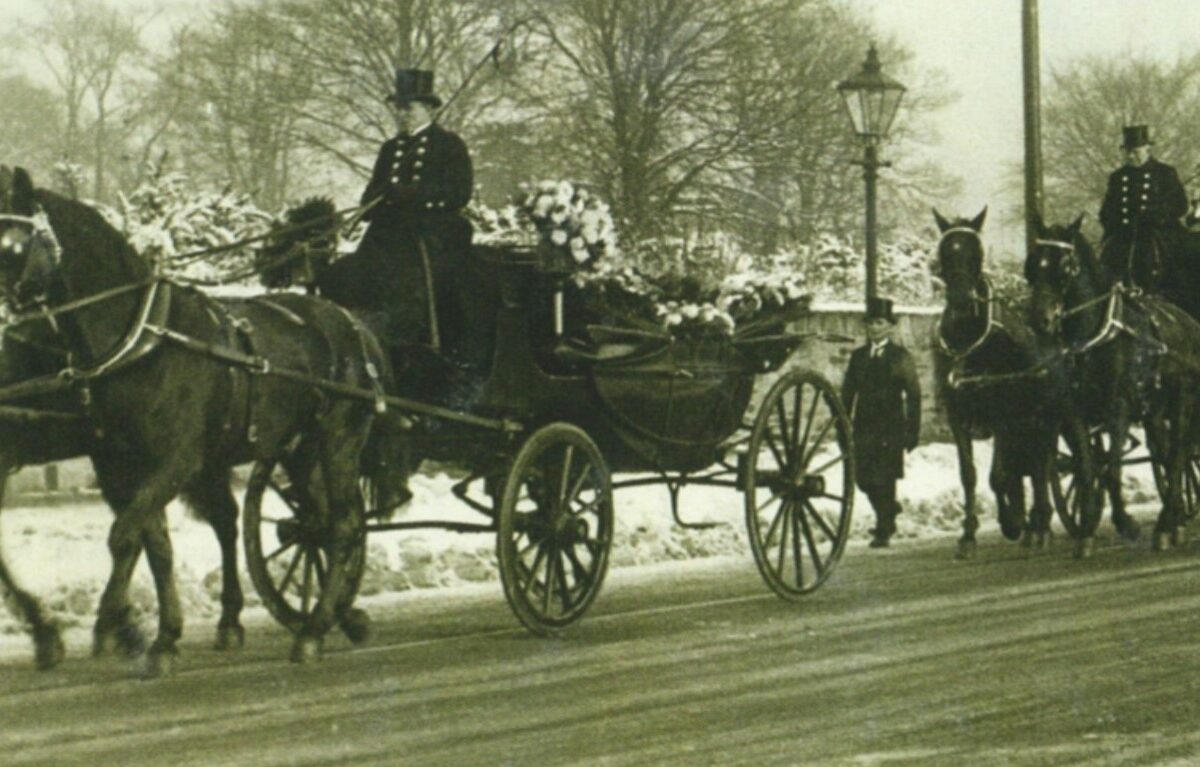
Horse Drawn Funeral Procession. Source: Jason Heath.
One element of Victorian funerals that was a clear signal of the status, or perhaps the aspiration, of the deceased and their family was the mode of transport used to convey a body to the cemetery for burial. The better off, and certainly the wealthiest families, would use carriages, both as the hearse and as transport for mourners. In the 1850s, when funeral rites and rituals were at their most ostentatious, the hearse might be drawn by four or more splendid black horses, complete with black feather plumes and highly polished trappings. The coffin would be covered with a funeral pall – usually of black, purple or white velvet. Further down the social scale a suitable pall was still important but the horse-drawn carriages were likely to be less elaborate and fewer in number. Many mourners would simple have walked behind the coffin from the deceased’s house to the cemetery.
Local businesses providing horse-drawn carriages, and later motorised vehicles, were numerous, often involving several members of the same family as with Thomas Thompson.
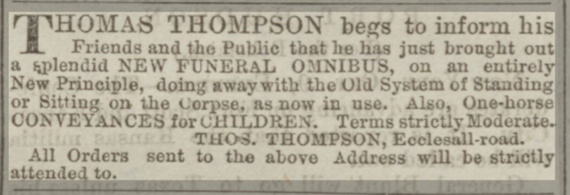
Thomas Thompson advert from the Sheffield Daily Telegraph 22 October 1863. Source: Local Studies.
In the 1871 census both Thomas and his wife Elizabeth are described as ‘coach proprietors’. They lived with five sons, two of whom are described as ‘cab drivers’, as well as his stepfather, wife and grandson at 27 Union Street. It is possible that Thomas and Elizabeth had relocated their business to Ecclesall Road to be closer to the General Cemetery, but we can’t be sure. One child of their marriage, Ada, died aged just 8 months, and was buried in the Anglican area of the Cemetery in plot F2 121 along with three other infant children and eight cab drivers and their family members so presumably employers.
A great variety of funeral carriages were in use through much of the nineteenth century but one in particular which receives frequent mention is the ‘Shillibeer’.
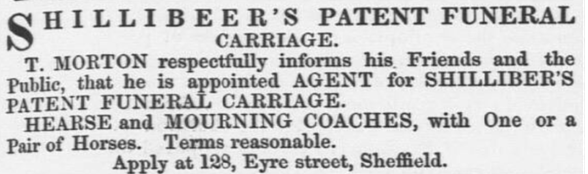
Advert for T Morton Shillibeers from Sheffield Independent, 3 February 1849. Source: Local Studies.
Shillibeers were a patented design and so only available from appointed agents such as T Morton. This vehicle, patented by George Shillibeer (1797-1866), combined space for both the mourners and the coffin. George Shillibeer was the first designer of horsedrawn coaches which transported large numbers of people, the forerunner to omnibuses. He had an eventful life, was imprisoned for not paying his taxes, smuggled French brandy, and spent some time in a debtors’ prison. After his release he adapted these large vehicles to include accommodation for the hearse as well as the mourners. This new form of vehicle reduced the cost of a funeral for the family. ‘Shillibeer’s Funeral Coaches’ were in common enough use in the early Victorian period for funerals to be described as ‘Shillibeer’ funerals. Shillibeer himself spent the last few years of life in the undertaking business, and indeed one of his hearses was exhibited at the Great Exhibition of 1851.
One funeral which took place in the General Cemetery was that of Ellen Thorpe. This account from the Sheffield Independent, 9 November 1881 illustrates both the commonplace use of shillibeers at this time and also the rowdy, sometimes violent, nature of crowds of mourners:
The circumstances attending the death of Ellen Thorpe, a girl 12 years of age, upon whose body an inquest was held on Friday last, have aroused considerable excitement in the neighbourhood of Cotton Mill walk. The funeral of the unfortunate girl took place yesterday afternoon, when the neighbourhood was all astir with a crowd of women and girls, who loudly threatened mob law directed chiefly against the father, John Thorpe, whose alleged treatment of his daughter in the last stages of her illness formed the subject of unfavourable comment on the part of the coroner’s jury. The services of the police were required to maintain order, but a crowd of nearly a hundred persons followed the shillibeer conveying the mourners and corpse to the General Cemetery. Many persons ran in front of the funeral procession and obtained admission to the cemetery before the arrival of the shillibeer, but the greater part of the crowd failed to obtain an entrance. and had to content themselves with clambering upon the railings and shouting.
Ellen Thorpe was buried in the Nonconformist area of the Cemetery in plot NN 85.
Later, in the twentieth century, a transition from horse-drawn carriages to motor vehicles gradually took place, but it was a slow and sometimes painful process. Jason Heath recounts how his family firm of funeral directors invested in motorised hearses in the 1920s but they were not always welcomed by mourning families. It is said that one woman in Sutherland Street opened her door and was horrified by the sight of the waiting motorcade; ‘I am not letting you rush my husband off in one of those things! Go and fetch the horses!’.
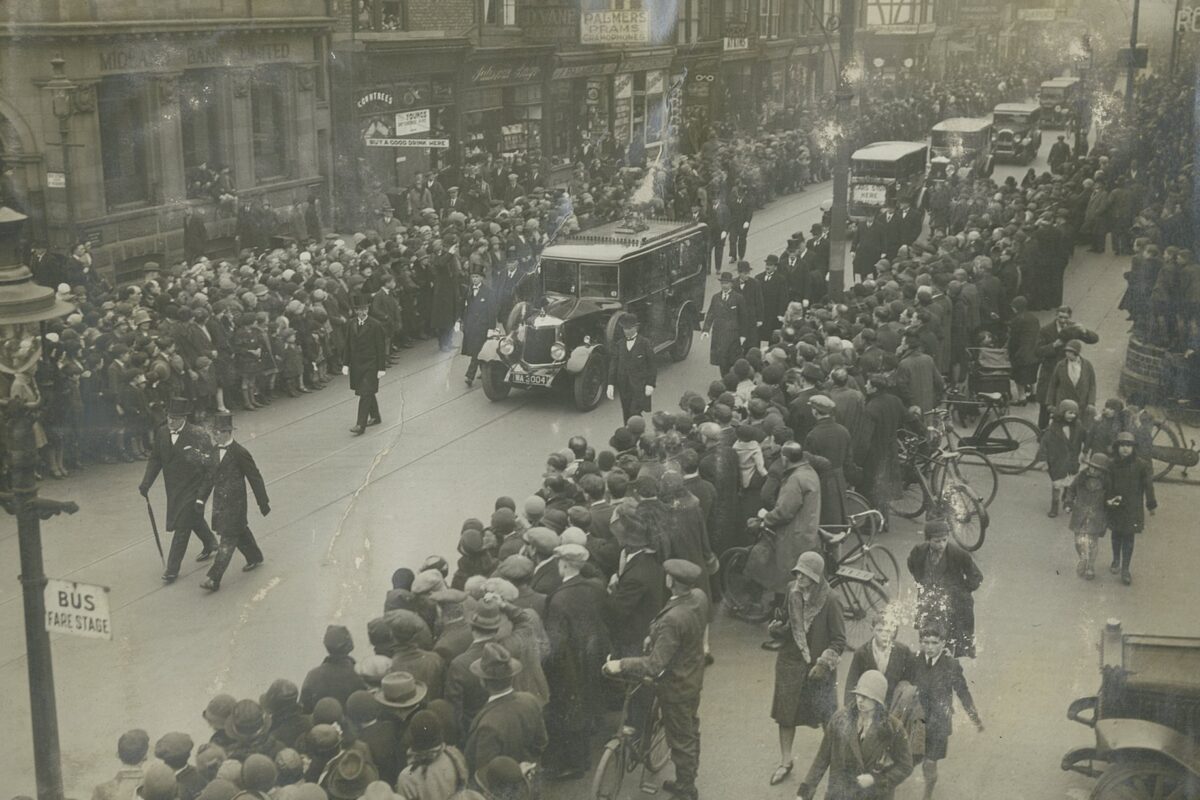
Funeral Procession with Motorised Vehicles. Source: Jason Heath.