


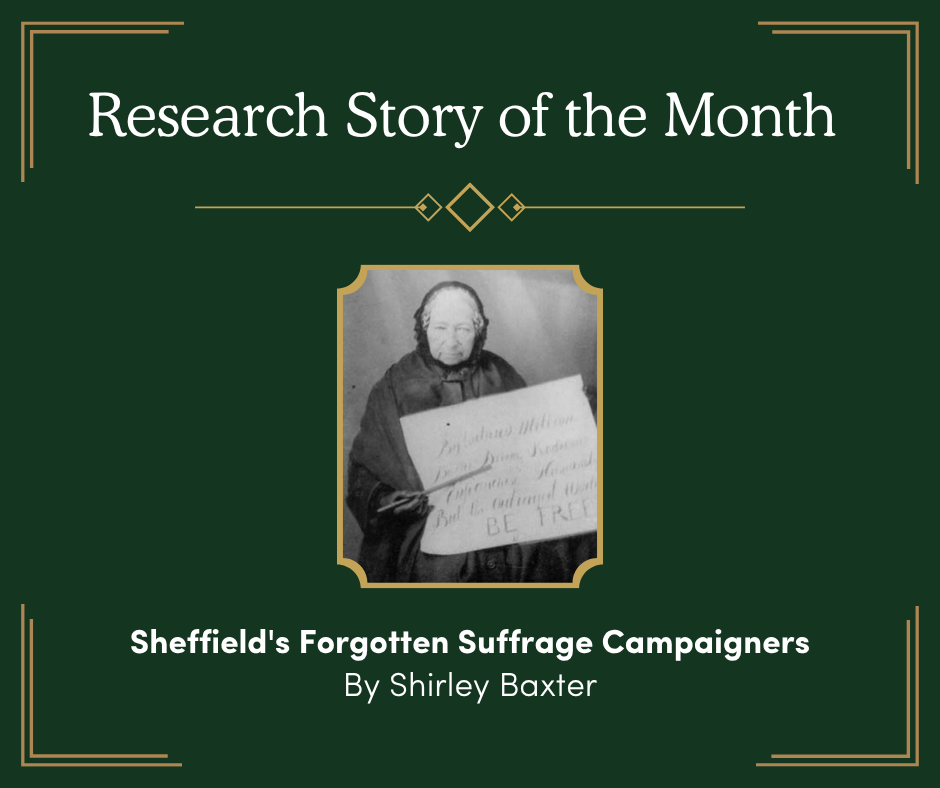
The battle of the suffragettes to obtain votes for women at the beginning of the twentieth century is well known and celebrated. The first breakthrough came in 1918, when women over thirty – who owned property – were given the right to vote, a right extended to all women over 21 with the passing of the 1928 Equal Franchise Act.
These two acts have been seen as a victory for the militant suffragettes, members of the Women’s Social and Political Union (WSPU), which was founded by Emmeline Pankhurst in 1903. What is perhaps less well known is that the WSPU was not the first women’s organisation to campaign for women’s votes.
The first women’s associations in the UK grew out of the Chartist movement of the 1830s, 1840s and 1850s, a mass working class movement demanding fair representation in Parliament and votes for all. Women were involved from the beginning, setting up their own groups, meeting, demonstrating, writing to the newspapers, raising awareness.
One such group was founded in Sheffield fifty years before the formation of the WSPU. Anne Knight, a social reformer and pioneer of feminism, asked Isaac Ironside, Chartist and councillor, if he could supply her with the names of women in Sheffield who were interested in campaigning for women’s suffrage. He gave her a list of seven politically active women, among them Eliza Rooke, who is buried in the Cemetery. Very little is known about Eliza except for the fact that she was married to Thomas Rooke, a confectioner and Chartist. Together Knight and these seven working class women formed the Sheffield Women’s Political Association. The first meeting was held on 26th February 1851, when it unanimously adopted ‘An Address to the Women of England’, a manifesto calling for female suffrage in Great Britain. Notably, the Sheffield Women’s Political Association presented the first ever petition for women’s suffrage to Parliament – where their demands were treated with derision.
Sadly, the life of the association was quite short, disappearing along with the crushing of the Chartist movement, which in itself was largely gone by the late 1850s. Eliza died in 1856, still in her thirties, and is buried in a public grave. Not until 1872 was the National Society for Women’s Suffrage formed, which in 1897 merged with other groups to became the National Union of Women’s Suffrage Societies, led by Millicent Fawcett. Gradually two factions emerged, those who believed in pursuing their aims by peaceful means, and those who became convinced that more aggressive tactics were necessary, leading to the formation of the WSPU – but the very beginnings of their ultimate success lay with working class Chartist women like Eliza Rooke, whose campaigning raised awareness and ensured that such a hotly debated issue never went away.